Welcome to the official website of CNIACS Automation Technology Co., Ltd!

Honeywell Sensepoint XCD Overview

Sensepoint XCD Overview

There are three different types of the XCD transmitter for use with three different

families of sensors.

The mV type transmitter is for use with the mV family of XCD sensors including

catalytic sensors to detect flammable gases in the range 0-100%LEL and infrared

(IR) sensors for detection of Hydrocarbon gases in the range 0-100%LEL.

Two IR Hydrocarbon sensors are available; one linearised to Methane and one

linearised to Propane. The Propane version has linear cross sensitivities factors for

Ethylene, Butane and Pentane. There is also an IR CO2 sensor available in the range

0-2%Vol.

The EC type transmitter is for use with the EC family of XCD sensors including

Carbon Monoxide (CO), Hydrogen Sulphide, (H2S), Nitrogen Dioxide (NO2)

and Hydrogen (H2).

The Oxygen transmitter is for use with the Oxygen (O2) XCD sensors.

A transmitter can auto-recognise any sensor from within its sensor family.

The sensor simply plugs into the bottom of the transmitter and the transmitter

automatically configures itself accordingly.
Honeywell E3Point Flexible Operation

Flexible Operation:

• Comes in standalone, standalone with remote (dual gas mode) or network versions

• Connects to analog or digital systems

• Works with virtually any BAS including BACnet and Modbus

• Connects to wired or wireless system (via 301CW wireless controller)

• Wall or duct mount

• Factory-calibrated cartridges

Cost Effective:

• Saves energy through Demand Control Ventilation (DCV)

• Simplifies installation/maintenance through plug-n-play sensor

• Remote sensor option provides dual gas monitoring (standalone version only)

• Optimizes BAS, fire, ventilation and other security systems

Versatile Communications:

• Works through BAS to improve fault diagnostics and collect data on gas

concentration levels, sensor condition, etc.

• Couple with 301C to log data and daisy-chain up to 96 E3Point units

Advanced Sensing Technology:

• Detects CO, NO2. O2. H2. H2S, CH4. C3H8

• Advanced electrochemical (for toxic gases)and catalytic bead

(for combustible gases) sensor performance

• Uses patented Reflex® and smart cartridge technologies

Electrical Certifications:

• US (ANSI/UL 61010-1)

• Canada (CSA C22.2 No. 61010-1)

Features & Benefits:

• Standalone, standalone with remote (dual gas mode) or network versions available

• Saves energy through Demand Control Ventilation

Quick Specs:

• Complete toxic and combustible gas detection system with onboard sounder

• Available in single point or dual gas options

• Analog 4-20 mA or Digital outputs (Bacnet, Modbus, and Lonworks)

Honeywell E3Point Gas Detector Product Overview

Commerical building toxic and combustable gas detector with remote sensor option

Product Overview:

E3Point is capable of detecting the widest range of toxic and combustible

gases found in commercial building spaces and outbuildings, including CO,

NO2. O2. H2. H2S, CH4 and C3H8. It can be used as a standalone unit with

single or dual-gas detection (i.e. using a remote sensor) or deployed as a

networkable device (interoperable with BACnet, Modbus or other Building

Automation System): E3Point also functions with existing controller-based

gas monitoring systems and wired-wireless gas monitoring system components.

E3Point uses Demand Control Ventilation—through relays, Building Automation

System (BAS) or controller—to increase energy savings, extend fan life and

align with green building best practices. In its network configuration, E3Point

also optimizes HVAC, fire/smoke, surveillance and other building systems

performance.

Intelligent product design reduces the unit’s cost of ownership while increasing

flexibility of application. Smart sensors are pre-calibrated, auto-configure upon

set-up and operate continuously on patented Reflex© technology which

continuously monitors sensor cell condition and alerts user to fault status.

The plug-n-play sensor cartridge, user-friendly menu and wiring options simplify

installation and maintenance, and reduce the cost of gas monitoring over the

life of the unit.

Honeywell 301C Additional Features and Benefits

Additional Features and Benefits:

• Zero maintenance

• User Friendly

• Automatic quick self-test and warm-up

• Continuous alphanumeric display

Inexpensive and Reliable:

• Low installation costs

• Allows for up to 126 zoning groups which can save energy and extend fan and relay life

• Manages up to 768 events with programmable latching alarms

Flexible Operation:

• Optional BACnet/IP available

• Interchangeable transmitters able to detect different gases

• Expands to handle up to 96 transmitters or relay modules

• Programmable time delays

• Integrated time clock enables scheduling of system operations

Safety Measures:

• Full array of visual indicators and integrated 65dBA alarm levels

• Fully programmable relays (can be set as fail-safe or not)

Beneficial Options:

• Available in a heavy-duty industrial housing

• Datalogging option

Features & Benefits:

• User friendly with zero maintenance

• Low installation costs

• Automatic quick self-test and warm-up

Quick Specs:

• Power requirement: 17-27 VAC, 24-38 VDC, 500 mA

• Size: 11 (W) x 8 (H) x 2.8 (D) in. (28 x 20.3 x 7 cm)

• Weight: 2.4 lbs. (1.1 kg)

Honeywell 301C Controller Product Overview

Controller for use in commercial building areas requiring multi-point gas monitoring

Designed for simple installation and operation, the 301C continuously monitors

and controls toxic gases, combustible gases and oxygen hazards.

Product Overview:

Using an addressable RS-485 Modbus communication protocol, the 301C uses

daisy chain wiring requiring only 2 pairs of wires to connect up to 96 transmitters

on the 3 input channels. This simplifies installation, in turn lowering costs.

The 301C’s zoning and averaging abilities significantly reduce operational and

maintenance costs.

Zoning / Averaging:

The 301C controller offers unique zoning capabilities which permit the averaging

and comparison of multiple sensor readings. Zoning can reduce operational costs

by ensuring that localized brief fluctuations registered at a single transmitter do

not activate relays. For example, a car idling in a parking structure may locally

increase a reading at a nearby transmitter. Rather than activating a fan as a result

of the temporary localized fluctuation, zoning can be used to limit relay activation

until the average reading for a zone exceeds a set-point. This can reduce run time

of fans, yielding savings in both energy usage and wear and tear. The 301C has the

capacity to manage input from three Modbus channels for up to 96 transmitters and

up to 50 wireless transmitters that can be associated with up to 126 zones.

Transmitters can belong to an unlimited number of zones, providing maximum

operational and control flexibility.

Honeywell 301IRF Additional Features and Benefits

Additional Features and Benefits:

User Friendly:

• State-of-the-art infrared sensor technology

• LED indicator

• Low-profile and rugged construction for low mounting in

chiller/mechanical room

Economical Solution:

• Cost-effective answer for installation in areas where refrigeration gas

hazards may be present

Detectable Gasses:

• R11. R22. R123. R125. R134A, R404A, R407C, R410A, R448A, R449A,

R507A, R513A, R514A, R4310. 1233ZD, 1234ZE.

Features & Benefits:

• Infrared sensing technology responds promptly

• Low-profile design suited for mounting directly to chiller pad or low

on nearby wall

• Low maintenance

Quick Specs:

• Power requirement operates on 12 VDC power only

• Dimensions 4” H x 11” W x 2.5” D (10.2 x 28 x 6.3 m)

• Weight 2.33 lbs (0.603 kg)

Honeywell 301IRF Refrigerant Gas Detector

Install Honeywell 301IRF sensor at low levels in chiller room for reliable

detection of a variety of refrigerant gasses. Requires installation with a

301EM-20 controller.

Product Overview:

Discreet design and rugged ABS-Polycarbonate housing for the 301IRFS

set the standard for “at the source” gas detection in a chiller room.

Mount directly to the chiller pad or low on the wall in close proximity

to achieve early notifications in the event of a refrigerant leak.

ASHRAE No 15-2001 Mechanical Standard and B-52 Code Compliance.

The ASHRAE and B-52 security standards have been established to

minimize risk and protect the safety of mechanical room personnel

and the environment at large. Honeywell’s 301IRF, together with the

301EM mechanical room controller, provides a complete solution that

meets and even exceeds these rigorous standards. The 301EM can be

configured to offer automatic fan, horn and strobe activation in addition

to manual fan activation when the 301IRF detects a refrigerant.

Honeywell ASHRAE No 15 Mechanical Standard and B-52 Code Compliance

ASHRAE No 15 Mechanical Standard

and B-52 Code Compliance

The ASHRAE and B-52 security standards have been established to

minimize risk and protect the safety of mechanical room personnel

and the environment at large. Available in a special configuration,

the 301EM-20 mechanical room controller has been carefully

designed to meet and even exceed these rigorous standards.

The 301EM can be configured to offer automatic fan, horn and

strobe activation in addition to manual fan activation.

Latching relay for manual alarm recognition, silence key for manual

horn deactivation, built-in 24 Vdc outputs for horn operation, and

2 breakglass switch accessories for manual alarm activation

ensure optimal performance.

User Friendly

• Easy to read LCD display

• Auto-diagnostic capabilities

Economical Solution

•  Cost-effective answer for installation in Mechanical

Rooms locations

Flexible Operation

• Able to operate with up to 20 remote sensors at a time

•  Various types of sensors available to simultaneously

detect a range of different Refrigerant, Toxic and

Combustible gases

• Robust and reliable RS-485 Modbus communication

Output Adaptability

• Three 24 Vdc alarm outputs and four 4-20 mA outputs

Safety Measures

• Four fully programmable relays

•  Three alarm levels with built-in visual indicators and

audible alarm

Beneficial Options

• Convenient stand-alone or network operation

Honeywell 301EM-20 Controller

The complete solution for Mechanical Rooms. Monitor up

to 20 sensors for Refrigerant, Toxic and Combustible gases.

The 301EM-20 acts as a controller for up to 20 remote

sensors and suits a variety of gas detection system solutions

for Mechanical Rooms.

Particularly configured to meet ASHRAE 15. B-52 and International

Mechanical Code requirements, the 301EM-20 is commonly used

to optimize gas detection in mechanical and chiller rooms. A full

complement of sensors (including toxic, oxygen, combustible gases

and a full line of refrigerant sensors), horns, strobes and remote

panels provide added flexibility to suit a variety of gas detection

system solutions.

Flexible Operation

• Able to operate with up to 20 remote sensors at a time

•  Various types of sensors available to simultaneously

detect a range of different Refrigerant, Toxic and

Combustible gases

• Robust and reliable RS-485 Modbus communication

Output Adaptability

• Three 24 Vdc alarm outputs and four 4-20 mA outputs

Safety Measures

• Four fully programmable relays

•  Three alarm levels with built-in visual indicators and

audible alarm

Beneficial Options

• Convenient stand-alone or network operation

ALSTOM AL129A Power Supply Module In-Stock

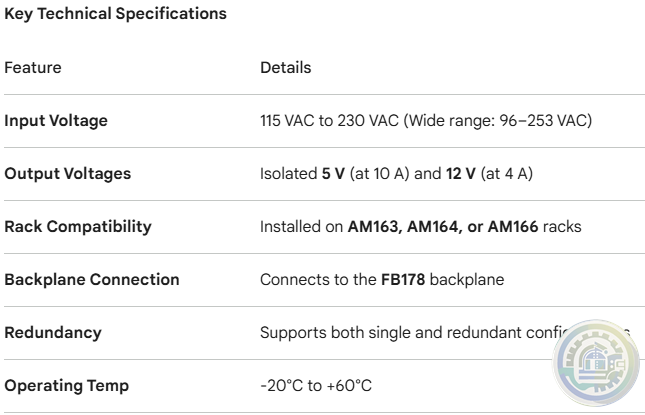
The AL129A (often listed as AL129A CD101152) is a critical Power Supply Module

primarily used in industrial automation and control systems.

It was originally manufactured by Alstom (and later GE following their acquisition

of Alstom’s power business).

It is a “chopper converter” style power module specifically designed for the Alspa

CE2000 and CE3000 series controllers, which are commonly found in power plants,

gas turbines, and HVDC (High Voltage Direct Current) transmission systems.

Common Applications Power Generation: Providing stable power to controllers for

gas, steam, and hydroelectric turbines.

Grid Infrastructure: Used in substation automation and HVDC systems to ensure

reliable protection and control equipment operation.

Industrial Automation: Integrated into complex control systems requiring high-efficiency

power conversion and “isolated” outputs to protect sensitive electronic components.

Status and Availability Since the Alspa CE2000/3000 series is an older platform,

the AL129A is frequently categorized as a “legacy” or “discontinued” part.

You will most commonly find it through specialized industrial surplus suppliers or

as a refurbished unit with a test certificate (often under the Alstom code U0100050).

Search for products

Back to Top
Product has been added to your cart